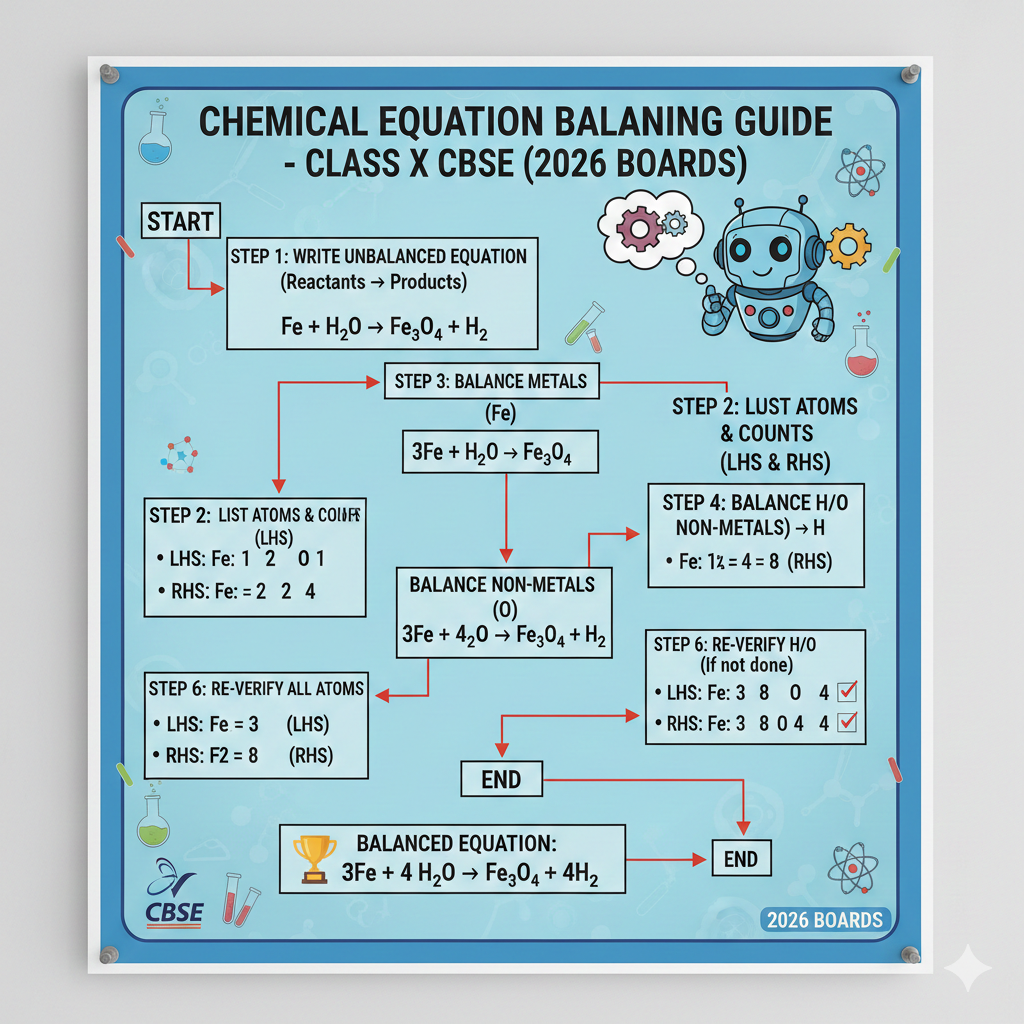
Chemical Equation Balancing Guide
✅ GRADE 8 — 10-MARK TOPPER ANSWERS
MATHEMATICS + SCIENCE (IPS + IPC Format)
📘 MATHEMATICS
CH–1 Numbers & Calculations
Q1 (10M): Explain BODMAS rule and solve an expression using it.
Answer (IPS+IPC)
I – Introduction
In mathematics, expressions often contain more than one operation.
To get the correct answer, we follow a standard order called BODMAS.
P – Procedure / Explanation
BODMAS stands for:
B → Brackets
O → Orders (powers, roots)
D → Division
M → Multiplication
A → Addition
S → Subtraction
Example
Solve:
8+4×(6–2)28 + 4 × (6 – 2)^28+4×(6–2)2
Step 1: Brackets
(6–2)=4(6 – 2) = 4(6–2)=4
Step 2: Orders
42=164^2 = 1642=16
Step 3: Multiplication
4×16=644 × 16 = 644×16=64
Step 4: Addition
8+64=728 + 64 = 728+64=72
C – Conclusion
Thus, by applying BODMAS correctly, the value of the expression is:
72\boxed{72}72
⭐ Keywords: Order of operations, brackets, powers, correct calculation
CH–4 Equations & Inequalities
Q2 (10M): Solve the equation and verify the solution:
3x–7=2x+53x – 7 = 2x + 53x–7=2x+5
Answer
I – Introduction
An equation is a statement showing equality between two expressions.
Solving means finding the value of the variable.
P – Stepwise Solution
Given:
3x–7=2x+53x – 7 = 2x + 53x–7=2x+5
Step 1: Bring variable terms together
Subtract 2x2x2x from both sides:
3x–2x–7=53x – 2x – 7 = 53x–2x–7=5x–7=5x – 7 = 5x–7=5
Step 2: Bring constants together
Add 7 to both sides:
x=12x = 12x=12
Verification
LHS:
3(12)–7=36–7=293(12) – 7 = 36 – 7 = 293(12)–7=36–7=29
RHS:
2(12)+5=24+5=292(12) + 5 = 24 + 5 = 292(12)+5=24+5=29
Since LHS = RHS, solution is correct.
C – Conclusion
Therefore, the value of xxx is:
12\boxed{12}12
⭐ Keywords: Transposition, balance method, verification
CH–11 Ratio & Proportion
**Q3 (10M): A recipe uses flour and sugar in ratio 3:2.
If flour is 450g, find sugar required.**
Answer
I – Introduction
A ratio compares two quantities of the same kind.
P – Solution
Flour : Sugar = 3 : 2
Flour = 450 g
So,
3 parts=450g3 \text{ parts} = 450g3 parts=450g1 part=450÷3=150g1 \text{ part} = 450 ÷ 3 = 150g1 part=450÷3=150g
Sugar = 2 parts:
2×150=300g2 × 150 = 300g2×150=300g
C – Conclusion
Thus, sugar required is:
300g\boxed{300g}300g
⭐ Keywords: Ratio, unitary method, proportional reasoning
🔬 SCIENCE
⚡ PHYSICS
Unit 3.1 Density
Q4 (10M): Define density and describe an experiment to find density of a solid.
Answer (IPS+IPC)
I – Introduction
Density is a physical property that tells how much mass is packed into a given volume.
P – Explanation
Definition
Density=MassVolumeDensity = \frac{Mass}{Volume}Density=VolumeMass
Unit: g/cm³ or kg/m³
Experiment to Find Density
Apparatus
Measuring cylinder
Water
Solid object
Weighing balance
Steps
Step 1: Measure mass
Suppose mass = 200 g
Step 2: Measure volume using water displacement
Initial water level = 50 cm³
Final water level = 80 cm³
Volume of solid:
80–50=30cm380 – 50 = 30 cm³80–50=30cm3
Step 3: Calculate density
Density=20030=6.67g/cm3Density = \frac{200}{30} = 6.67 g/cm³Density=30200=6.67g/cm3
C – Conclusion
Thus, density depends on both mass and volume and can be found using displacement method.
⭐ Keywords: Mass, volume, displacement, physical property
Unit 9 Electricity
Q5 (10M): Explain parallel circuits and why they are used in homes.
Answer
I – Introduction
A parallel circuit has components connected in separate branches, providing multiple paths for current.
P – Explanation
Features
Voltage is same across each branch
Current divides among branches
Devices work independently
Diagram
   Bulb 1
---( )---|
         |
---( )---| Bulb 2
         |
---( )---| Bulb 3
Advantages
If one bulb fails, others continue working
Each appliance gets full voltage
Safe and reliable for wiring
C – Conclusion
Therefore, parallel circuits are preferred in household wiring for efficiency and safety.
⭐ Keywords: Branches, same voltage, household wiring
🧪 CHEMISTRY
Unit 5 Reactivity Series
Q6 (10M): Explain the reactivity series and its importance.
Answer
I – Introduction
The reactivity series is an arrangement of metals in decreasing order of their chemical reactivity.
P – Reactivity Order
K>Na>Ca>Mg>Al>Zn>Fe>Cu>Ag>AuK > Na > Ca > Mg > Al > Zn > Fe > Cu > Ag > AuK>Na>Ca>Mg>Al>Zn>Fe>Cu>Ag>Au
Importance
Predict displacement reactions
Example:
Zn+CuSO4→ZnSO4+CuZn + CuSO_4 → ZnSO_4 + CuZn+CuSO4→ZnSO4+Cu
Metal extraction
Highly reactive metals need electrolysis.
Corrosion prevention
Less reactive metals resist rusting.
C – Conclusion
Thus, reactivity series helps in understanding metal behaviour in reactions.
⭐ Keywords: Displacement, extraction, reactivity order
🌱 BIOLOGY
Unit 1 Photosynthesis & Carbon Cycle
Q7 (10M): Describe photosynthesis with equation and its role in carbon cycle.
Answer
I – Introduction
Photosynthesis is the process by which green plants prepare food using sunlight, CO₂ and water.
P – Process Explanation
Occurs in chloroplasts containing chlorophyll.
Equation:
6CO2+6H2O→lightC6H12O6+6O26CO_2 + 6H_2O \xrightarrow{light} C_6H_{12}O_6 + 6O_26CO2+6H2OlightC6H12O6+6O2
Role in Carbon Cycle
Plants absorb CO₂
Produce oxygen
Animals consume plants
Respiration returns CO₂
Flow:
CO₂ → Plants → Animals → CO₂
C – Conclusion
Thus, photosynthesis is essential for life, oxygen supply and carbon balance.
⭐ Keywords: Chlorophyll, glucose, carbon cycle, oxygen
Unit 7 Genes & Inheritance
Q8 (10M): What are genes? Explain inheritance with example.
Answer
I – Introduction
Genes are the basic units of heredity present on chromosomes.
They control traits passed from parents to offspring.
P – Explanation
Genes carry instructions for features like height, eye colour
Offspring inherit genes from both parents
Example:
Parents: Tall trait dominant
Child likely inherits tallness
C – Conclusion
Thus, genes ensure continuity of characteristics across generations.
⭐ Keywords: Heredity, chromosomes, traits, inheritance
Commenting is not enabled on this course.